I am soooo far behind on this! And what's more I'm not really doing a book, but books - that is: there are a couple of people whom I have read extensively, and whilst one book on its own may not have revolutionised my life, the cumulative effect of multiple volumes over several years has been huge. So, apologies out of the way:
I know the verdict has gone from "Beware!" in reformed circles to uber-cool in recent years (ie via Keller, Piper etc) but I have been reading Lewis since...well probably early teens, well before I became a Christian. In fact, as with many, I suspect some of Narnia will have introduced ideas and concepts which later enabled resonance when reading the Bible for the first time. Verbal creation ex nihilo, substitutionary atonement, temptation, virtue...

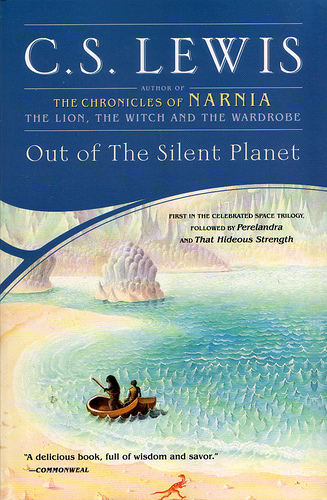
Later, the science fiction trilogy enhanced a feel for a personal universe, good and evil, the Fall.
And then the mountains of essays. Firstly for the way they were written: clarity, precision, the mathematical dissection of the opposition's contention. If only we could all express ourselves that way. Secondly, the content: piercing, relevant, profound, memorable. And especially when communicating heaven and hell, and the profound simplicity of everyday life.
Of course the warnings about Lewis were also true: too often when encountering a problem in the Bible, he would process it via intellect much more than Scripture, and was prone to wandering off in some very odd directions.
But he could still write nonsense better than most true blue evangelicals can write truth.
And he gave me a sense of warmth in theological writing that seemed absent many other places (especially in my early days), and he said it was OK to have an imagination, and he taught me the power of story, and that the motif of redemption turns up everywhere. And, by accident, he taught me not to put my Bible down and go off on my own. And if it were not for fear of cancer, I'd probably buy a pipe too.
Friday, August 05, 2011
Thursday, August 04, 2011
Instead of productivity
HT (see I said it) to Minty. Comments towards the end of an article on what to do when attempts at productivity are going wrong - I put these here to remind me someone said them when I'm doing the opposite:
You could:
You could:
- Re-examine your definition of productivity. Spending two hours reading a great book in a coffee shop could well be more productive than spending two hours staring at your computer screen. Taking care of your kids could be one of the most productive things you’ll do in your whole life.
- Plan some down-time. Take an afternoon off – or a whole weekend. If you plan ahead, you’ll have it to look forward to (and you’re more likely to actually hold yourself to it).
- Find leisure activities that you really enjoy. Sometimes, we get caught up in productivity – whether that’s at work or in the home – because we don’t really have anything else to do. Join a club, take up a new hobby, or plan a date night with your partner.
- Get away from it all. It can be hard to “switch off” from work at times. By getting physically away – to a different city or even a different country – you create a real break from your regular life.
Tuesday, August 02, 2011
Piper: Baptism in perspective
I think we need to teach our people the meaning of baptism and obey the Lord's commands to baptise converts (Matt.28:19), without elevating the doctrine to a primary one that would unduly cut us off from shared worship and ministry with others who share more important things with us.
Brothers, p135
Lucado: questions
When a person first asks you a question, are they just testing to see if you can be trusted?
Yes, a person's first question isn't really the question. Their first question is kind of like tossing the tennis ball into the air. It's a practice swing. They're just testing to see if I am listening to them or not.So I make a habit of following up the first question with a question of my own: "Can you give me an example of that? When did that last happen to you? What effect has that had on you?" When I do that, I find that I hear them better.If I answer too quickly, my odds of providing a good answer diminish. Sometimes people don't want an answer; they just want to be heard. They just need to get something off their chests.I heard a counselor once say, "Try to find the question behind the question." That's good advice for pastors. Even when people come at you and they're a bit antagonistic, I'll sometimes be so bold as to say, "Now, what's the question behind this question? What do you really want to talk about?"
Monday, August 01, 2011
Schaeffer: the church exhibiting God
Ever since the fall rebellious man has been this way. And the Church is called out of this humanity, in order to be humanity before a lost humanity...
It is not only that the individual should so think and live, but the whole group as a group should be attuned to living consciously, moment by moment, in the reality of the supernatural. Then there is the exhibition; then there is the result there should be.
The Church should represent the supernaturally restored human race in reality, and as such it is very obvious
that there must be the proper legal circle of those in the Church in distinction to those not in it.
The matter of the proper legal circle, the battle against false doctrine and sin, will never come to an end in this life. But the proper legal relationship, while right in itself, should be only the vestibule to the reality of a living, personal relationship, first the group with God and then between those who are in the Church. Really to glorify God, to enjoy him, and to exhibit him, can never be mechanical and can never be only legal, but personal. When the Church of Christ functions on less than the personal level, it is exhibiting less than what God is, and therefore it is less than the Church should be. There should be an exhibition of redeemed human personal relationships.
TS, p146-148
Schaeffer: divorce
Modern multiple divorce is rooted in the fact that many are seeking in human relationships what human relationships can never give.
TS, p142
Schaeffer: value and apologies
So it is not such a low door after all, because all it involves is being willing to admit our equality with the one we have hurt. Being his equal it is perfectly right that I should want to say, "I am sorry." Only a desire to be superior makes me afraid to confess and apologize.
If I am living in a real relationship with the Trinity, my human relationships become more important in one way, because I see the real value of man, but less important in another way because I do not need to be God in these relationships any longer. So now I can go up to a man and say, "I am sorry for such and such specific harm I have done you," without smashing the integration point of my universe, because it is no longer myself, but God.
TS, p139-40
Schaeffer: love the individual
...every time I come into a place of eminence of office, I am to do it with trembling because I must understand from the word of God that eventually I will give account of my stewardship, not only in regard to my proper legal relationships but on the basis of my personal relationships.
One of the problem with humanists is that they tend to "love" humanity as a whole - Man with a capital M, man as an idea - but forget about man as individual, as a person. Christianity is not to love in abstraction, but to love the individual who stands before me in a person-to-person relationship.
TS, p138
Friday, July 29, 2011
Franzen: controllable extension of self
To speak more generally, the ultimate goal of technology, the telos of techne, is to replace a natural world that's indifferent to our wishes — a world of hurricanes and hardships and breakable hearts, a world of resistance — with a world so responsive to our wishes as to be, effectively, a mere extension of the self.
NY Mag
Facebook and Guttenberg
The shortcomings of social media would not bother me awfully if I did not suspect that Facebook friendship and Twitter chatter are displacing real rapport and real conversation, just as Gutenberg's device displaced remembering.
New York Magazine
Wednesday, July 27, 2011
Schaeffer: being right without crushing people
...if we as individual Christians, and as the church, act on less than a personal relationship to other men, where is the demonstration that God our Creator is personal?
...As Christians we are not to fellowship with false doctrine. But in the midst of the very battle against false teaching, we must not forget the proper personal relationship.
In the midst of being right, if self is exalted, my fellowship with God can be destroyed...
...how careful I must be, every time I see a situation where I am right and another man is wrong, not to use it as an excuse to scramble into a superior position over that man, rather than remembering the proper relationship of fellow creatures before God.
TS, p135-136
Friday, July 22, 2011
Lewis: how to be a Knight
The medieval knight brought together two things which have no natural tendency to gravitate toward one another. It brought them together for that very reason. It taught humility and forbearance to the great warrior because everyone knew by experience how much he usually needed that lesson. It demanded valour of the urbane and modest man because everyone knew that he was as likely as not to be a milksop.
Piper: repentance through beauty
So preaching that aims to produce true evangelical remorse and contrition must devote itself to making God and His holiness look alluringly attractive and satisfying, so that, by the grace of regeneration and illumination, people will come to love it so much that they feel intense remorse over falling short of it. In other words, we must preach for joy in the glory of God if we would produce true grief over falling short of the glory of God. Evangelical repentance is grounded in an appealing sight of the holiness of God. That is why I say, brothers, pursue their repentance through their pleasure.
Brothers... p125
Thursday, July 21, 2011
2 minutes of life
Marshall Shelley's son lived for 2 minutes, and he was left asking why God would create someone who only lived that long? At the end of the article he writes:
The apostle John's vision of eternity suggests what's in store for all the saints: "The throne of God and of the Lamb will be in the city, and his servants will serve him. They will see his face, and his name will be on their foreheads …. And they will reign forever and ever" (Rev. 22:3-5).I don't know exactly what our service in that city will involve, nor can I be specific about how we will assist in reigning. But those tasks sound like they may have a bit more significance than most careers we pursue in our current lifetime.Could it be that when I finally start the most significant service of my life, I'll find that this is what I was truly created for? I may find that the reason I was created was not for anything I accomplish on earth, but the role I'm to fulfill forever.I realized that my earlier question had been answered.Why did God create a child to live two minutes?He didn't.He didn't create Toby to live two minutes or Mandy to live two years. He didn't create me to live 40 years (or whatever number he may choose to extend my days in this world).God created Toby for eternity. He created each of us for eternity, where we may be surprised to find our true calling, which always seemed just out of reach here on earth.
Tuesday, July 19, 2011
Schaeffer: how not to crush a relationship
But when I am a creature in the presence of God, and I see that the last relationship is with an infinite God, and these human relationships are among equals, I can take from a human relationship what God meant it to provide, without putting the whole structure under an intolerable burden. More than this, when I acknowledge that none of us are perfect in this life, I can enjoy that which is beautiful in a relationship, without expecting it to be perfect.
But most of all, I must recognise that no human relationships are going to be finally sufficient. The finally sufficient relationship must be with God Himself.
TS, p134.
Thursday, July 14, 2011
Schaeffer: legalistic, subhuman evangelism
The command is to love Him, not just to think about Him or to do things for Him...Saying this we can see that much evangelism is not only sub-Christian, but subhuman - legalistic and impersonal.
TS, p133
Creative Leaders
The role of a creative leader is not to have all the ideas; it’s to create a culture where everyone can have ideas and feel that they’re valued. So it’s much more about creating climates. I think it’s a big shift for a lot of people.
Ken Robinson
(pinched from Mintie; or HT; or something; HP?)
Novels satisfy spiritual hunger
Rowling did not create the truth of the Eliade thesis, that novels satisfy a spiritual hunger in a secular culture. But her saga has confirmed it spectacularly. Harry Potter revealed rather than created the great spiritual hunger of our time. The publishing industry and Hollywood are responding to this by delivering stories that borrow Rowling's model. The industry simply cannot ignore the Potter-Twilight elephants in the accounting room.
CT
Scheaffer: God's attention
...because God is infinite he can deal with each one of us personally as though each one was the only man who existed...
Prayer is always to be seen as a person-to-person communication, not merely a devotional exercise. Indeed, when prayer becomes only a devotional exercise, it is no longer biblical prayer...
TS, p131 & 132
Wednesday, July 13, 2011
Schaeffer: a moment by moment person to person relationship
If I refuse my place as creature before the Creator and do not commit myself to Him for His use, this is sin. And anything else is also misery. How can you enjoy God on any other level than what you are, and in this present situation? Anything else will bring misery, a torturing of the poor, divided personality we are since the Fall. To live moment by moment through faith on the basis of the blood of Christ, in the power of the Holy Spirit is the only really integrated way to live. This is the only way to be at rest with myself, for only in this way am I not trying to carry what I cannot. To do otherwise is to throw away my own place of rest, the substantial psychological advance I as a Christian can have in this present life.
But present communion with God requires bowing in both the intellect and the will. Without bowing in the intellect, in thinking after God; without acting on the finished work of Christ in my present life; and without bowing in the will in practice, as the waves of the present life break over me, there is no sufficient communion with God. Without these things I am not in my place as the creature in a fallen and abnormal world. These three things are absolutely necessary if there is to be real and sufficient communion with God in the present life. In the proportion that these things are so, then a person-to-person relationship to God is in place...
TS, pp.129&130
Schaeffer: one integration point
The integration point is God Himself. It is possible even for Christians to put always more intellectual questions between them and the reality of communion with God. Even right doctrine can be the false integration point...
...And almost all modern liberal theology is just a game; it is pure gamesmanship...
TS, pp127-128
Monday, July 11, 2011
Schaeffer: a new start, integration, encompassing relationship
There is always the possibility of a truly new start within a totally rational framework. Thank God that there is always this possibility, upon the basis of the infinite value of the blood of Jesus Christ...
...When by the grace of God I think after God, I can have intellectual integration. I no longer have to play games of hide and seek with the facts that I dare not face...
And nothing less will integrate the whole me, because that is what I was made for: to love God with all my heart, soul, mind. Being in any other relationship is not enough. There are parts of me that are not encompassed by any other relationship.
TS, p126.
Schaeffer: we know what we are so no need for superiority or inferiority
...another area of conflict and tension: the area of feelings of superiority and inferiority in relationship to other people. Many of us move backwards and forwards between superiority and inferiority , almost like the swing of a pendulum...
...As a Christian I do not have to find my validity in my status, or by thinking myself above other men. My validity and my status are found in being before the God who is there...I can deal with them without fearing that if I limit my superiority, my value, my validity, and status will be totally lost...
...I know who I am. I am a creature. I see myself in the light of having been created by God and in the light of the true , historic fall. So I understand that this is what I am and what all other men are.
TS, pp125&126
...As a Christian I do not have to find my validity in my status, or by thinking myself above other men. My validity and my status are found in being before the God who is there...I can deal with them without fearing that if I limit my superiority, my value, my validity, and status will be totally lost...
...I know who I am. I am a creature. I see myself in the light of having been created by God and in the light of the true , historic fall. So I understand that this is what I am and what all other men are.
TS, pp125&126
Schaeffer: fear of the impersonal
But the solution for the Christian is that there never need be a fear of the impersonal, because the personal-infinite God is really there...
..."you do not have to be afraid because God is here." This is a profound truth, not just for children. Indeed it is the glory of the Christian faith that the little things are profound and the profound things are overwhelmingly simple.
TS, p123
Schaeffer: trying to carry the world
The basic psychological problem is trying to be what we are not, and trying to carry what we cannot carry. Most of all, is not being willing to be the creatures we are before the Creator...there is nothing complicated about it; he is squashed trying to bear what no one except God Himself can bear because only God is infinite...
...Since the Fall we have points of weakness. With some of us it tends to be physical; with some it tends to be psychological. If we carry what we cannot, the blowout will come and it will come at the place of our inherent weakness...We refuse to acknowledge the existence of God, or - even though acknowledging his existence intellectually - in practice we refuse to bow before Him in the midst of our moment by moment lives.
TS, p122
Schaeffer: avoiding psychological despair and smashed marriages
...we lose the 'substantially' [substantial healing] in beating ourselves to bits trying to be what we cannot be...I am not to set myself at the centre of the universe and insist that everything bend to the standards that I have set upon my own superiority. I am not to say "I must be thus," and if it is not thus, there is nothing but psychological despair. Some people are totally caught in this, but all of us have something of it within ourselves, swinging pendulum-like between conceit and despair.
This is not true only in the psychological area, of course; it is true in all relationships of life...married couples who refuse to have what they can have , because they have set for themselves a false standard of superiority. They have set up a romanticism, either on the romantic side of love or the physical side, and if their marriage does not measure up to their own standards of superiority, they smash everything to the ground...You suddenly see a marriage smashed - everything gone to bits, people walking away from each other, destroying something really beautiful and possible...
TS, p120
Schaeffer: real and psychological guilt
Then it is reasonably, truly, and objectively dealt with in Christ's infinite substitutionary work. Now I can say to my conscience, "Be still!" The real guilt is gone and I know that anything that is left is my psychological guilt. This can be faced, not i confusion, but to be seen as part of the misery of fallen man...
A very practical thing for ourselves and for those whom we would help is that it is not always possible to sort out true guilt from psychological guilt...When someone comes to you in a psychological storm, and he is really torn up, it is not only unreasonable but it is also cruel to ask him in every case to sort out what is true guilt and what is psychological guilt...
...My part is to function in what which is above the surface, and to ask God to help me to be honest. My part is to cry to God for the part of the iceberg that is above the surface and confess whatever I know is true guilt there, bringing it under the infinite, finished work of Jesus Christ...
TS pp115-117
Schaeffer: acting like God is there
How is it that psychologists who act as if God is there, but merely pragmatically, like Carl Gustav Jung, are able to help their patients to some degree? I think it is because that which really helps is always in the direction of what reality is...Not bowing, they do not acknowledge Him, and yet pragmatically they find they must act as if He is there.
TS, p115
Friday, July 08, 2011
Schaeffer: battle
True doctrine is an idea revealed by God in the Bible...and can be fed back through man's body into his thought-world and there acted upon. the battle for man is centrally in the world of thought...the spiritual battle, the loss of victory, is always in the thought-world.
TS, p108.
Schaeffer: communion is internal
...we must understand that the reality of communion with God, and loving God, must take place in the inward self...Even communication with men and women must be through the body into the area of the thought-world...a real, personal communication never remains external. It always goes back into the personality...Thus real communication with man and love of man centres in our thought-world. The results may be external, and the expression may be external, but the love is internal. the same is true in our love for God...
the facts of the gospel in the external world [are] carried through the medium of his body into the inner world of his thoughts, and there, inside himself, inside his thought-world, either his believing God on the basis of the content of the gospel or his calling God a liar....
TS, p106
the facts of the gospel in the external world [are] carried through the medium of his body into the inner world of his thoughts, and there, inside himself, inside his thought-world, either his believing God on the basis of the content of the gospel or his calling God a liar....
TS, p106
Schaeffer: internal & external greatness & awfullness
So this is where true spirituality in the Christian life rests: in the realm of my thought-life...
...the reverse of this: the blows of the battle from the external world of man fall upon me outwardly. The blows fall in many ways...All of them come upon me in the external world, but if they stayed in the external world of the body, as though it were a machine, they would being no tears to me. Instead they flow through my sense, my body, into that which I am in the thought-world. And as the blows come to my thought-world, I either say "Thank you" to God, as we have already considered, or I rebel against Him. In either case the result is soon seen in the external world...
...That is even after I am a Christian I can be a death-producing machine; though I have life, eternal life, if I yield myself to Satan instead of to Christ, I can be an instrument of death to this external world. How sublime to be a man, made in the image of God! But how sobering, that I can bring forth out of my thought-world into the external world either that which leads to life or that which produces death in other men.
TS, pp106-107
Schaeffer: thoughts and internal are central
Basically it is a matter of our thoughts. The external is the expression, the results. Moral battles are not won in the external world first. They are always a result flowing naturally from a cause, and the cause is in the internal world of one's thoughts [for out of the abundance of the heart the mouth speaketh - MT.12:34]
There are those who would make a distinction here and regard the "heart" as more than just thoughts, but even if one held this view, the important fact is simply that we are dealing with the internal world. What Jesus is saying is that if the internal condition is not right, one cannot bring forth proper results.
[MT.5:21-22 & 1JN.3:15 - anger and hate is murder]
So far we have taken three steps:
First: the internal is first;
Second: the internal causes the external;
Third: morally, the internal is central
TS, pp98-99
Schaeffer: acknowledging and saying thanks
[on being unable to see all our sin]
TS, p90,92
But whatever evil may be above the surface, the portion that we do comprehend is sin, and that portion must be taken with honesty before God who knows our whole being, and we must say to Him, "Father, I have sinned." There must be real sorrow for the sin that I know, that is above the surface of myself...
...if we have sinned, it is wonderful consciously to say, "Thank you for a completed work," after we have brought that specific sin under the finished work of Christ...
TS, p90,92
Schaeffer: walking with Him in His will
If we have sin in our lives, and we go on, and God does not put His hand in loving chastisement upon us, then we are not children of God. God loves us too much for that. He loves us tremendously. He loves us as adopted children.
...God the Father's chastening is to cause us to acknowledge that specific sin is sin...
...Christ is speaking as a true man, and He speaks the absolute reverse of Adam and Eve in the Garden of the Fall, when He says, "Not my will, but Thine be done." I, too, must say with meaningfulness, "Not my will but Thine be done," at the point of that specific sin; not just a general statement, "I want your will" but "I want your will in reference to this thing that I acknowledge to be sin."
If we say that we have fellowship with Him and walk in darkness, we lie, and do not the truth. (1John1:6)
There is no such thing as to continually walk in darkness and to have an open fellowship with Him who is only light and holiness. This is simply not possible...
Here is something that is the antithesis not only of God's external law, but of His Character and what he is. How can we say we have fellowship with Him if we deliberately walk in that which is the antithesis of Himself?
TS, pp88-89
Schaeffer: sin obscures relationship
For some reason my moment-by-moment belief in God falters - a fondness for some specific sin has caused me at that point not to draw in faith upon the fact of a restored relationship with the Trinity. The reality of the practice of True Spirituality suddenly slips from me. I look up some morning, some afternoon, some night - and something is gone, something I have known; my quietness and peace are gone. It is not that I am lost again, because justification is once for all. But as far as man can see, or even I myself, at this point there is no exhibition of the victory of Christ upon the cross. Looking at me at this point, men would see not demonstration that God's creation of moral rational creatures is not a complete failure, or even that God exists. Because God still holds me fast, I do not have the separation of lostness, but I do have the separation from my Father in the parent-child relationship. And I remember what I had.
TS, p87.
Schaffer: sanctification is of Christ
To the extent that I am thinking about my sanctification, there is no real sanctification. I must see it always as Jesus Christ's.
...If I look to Jesus Christ and His victory for my entrance into a future heaven, dare I deny to him what that victory should produce in the battles of this present life - the battles before men and angels and the supernatural world? What an awful thought!
TS, p85&86
The Grand narrative and shaping life
To miss the grand narrative of Scripture is a serious matter; it is not simply a matter of misinterpreting parts of Scripture. It is a matter of being oblivious to which story is shaping our lives. Some story will shape our lives. When the bible is broken up into little bits and chunks - theological, devotional spiritual, moral, or worldview bits and chunks - then these bits can be nicely fitted into the reigning story of our own culture with all its idols! One can be theologically orthodox, devotionally pious, morally upright, or maybe even have one's worldview categories straight, and yet be shaped by the idolatrous Western story. The Bible loses its forceful and formative power by being absorbed into a more encompassing secular story.
Wolters & Goheen, quoted in Collins, Did Adam & Eve Really Exist?, p27
Lewis: books for grown ups (symbolism and imagery)
There is no need to be worried by facetious people who try to make the Christian hope of "Heaven" ridiculous by saying they do not want "to spend eternity playing harps" The answer to such people is that if they cannot understand books written for grown-ups, they should not talk about them. All the scriptural imagery (harps, crowns, gold, etc) is of course, a merely symbolical attempt to express the inexpressible. Musical instruments are mentioned because for many people (not all) music is the thing known in the present life which morst strongly suggests ecstasy and infinity. Crowns are mentioned to suggest the fact that those who are united with God in eternity share His splendour and power and joy, Gold is mentioned to suggest the timelessness of Heaven (gold does not rust) and the preciousness of it. People who take these symbols literally might as well think that when Christ told us to be like doves, He meant we were to lay eggs.
CSL, Mere Christianity, (quoted Collins Did Adam & Eve Really Exist? p18)
Schaeffer: the size God has made us
The reality of living by faith as though we were already dead, of living by faith in open communion with God, and then stepping back into the external world, as though we are already raised from the dead, this is not once for all, it is a matter of moment-by-moment faith, and living moment-by-moment. This morning's faith will never do for this noon...of noon for suppertime..of suppertime for going to bed...of midnight for the next morning. Thank God for the reality for which we were created, a moment-by-moment communication with God Himself. We should indeed be thankful because the moment-by-moment quality brings the whole thing to the size which we are, as God has made us.
...when we were created we were created for a purpose. And the purpose of creation, in which all our subsidiary purposes fit, is to be in a personal relationship to God, in communion with Him, in love, by choice, the creature before the Creator.
TS, pp.78-79
Schaeffer: moment by moment faith in Christ for life
So what is needed is the knowledge of the meaning of the work of Christ in our present life, for our present life, and then for us to act upon it in faith.
However, we may know the doctrine by mental assent without making the doctrine ours, and that is the other reason we do not bring forth the fruit we should. In the last analysis it is never doctrine alone that is important. It is always doctrine appropriated that counts...
If we are Christians, we have understood and acted upon the finished work of Christ once for all at our justification, and our guilt is gone forever. Now let us understand and act upon the practice of that same work moment by moment in our present lives...
So we must believe God's promises at this one moment in which we are. Consequently in believing God's promises we apply them - the present meaning of the work of Christ for the Christian - for and in this one moment. If you only can see that, everything changes. As we believe God for this moment, the Holy Spirit is not quenched. And through His agency, the risen and glorified Christ, as the Bridegroom of the bride, the Vine, brings forth His fruit through us at this moment. This is the practice of active passivity. And it is the only way anybody can live; there is no other way to live but moment by moment.
TS, pp76-77.
Schaeffer: oceans and orchards and vineyards wait
The Holy Spirit is the agent of the whole Trinity. He is the agent of the crucified, raised, the glorified Christ. If I am bringing forth something other than the fruit of the Spirit, the only reason is that I have grieved the Holy Spirit who is our divine guest....
...when we grieve Him, we push aside the one who is the agent to us of the work of Christ for our present life. On the basis of the finished, passive work of Christ - that is, His suffering on the cross - and on the basis of the active obedience of Christ - that is, keeping the law perfectly through His life - the fruits are there. They are there to flow out through the agency of the Holy Spirit through us to the external world. The fruits are normal; not to have them is not to have the Christian life which should be considered usual. There are oceans of grace that wait. Orchard upon orchard waits, vineyard upon vineyard waits. There is only one reason why they do not flow out through the Christian's life, and that is the instrumentality of faith is not being used. This is to quench the Holy Spirit. When we sin in this sense, we sin twice: we sin in the sin, and this is terrible, as it is against the law and character of God Himself, our Father; but at the same time we sin by omission, because we have not raised the empty hands of faith for the gift that is there.
In the light of the structure of the total universe, In the light of our calling to exhibit the existence and character of God between the Ascension and the Second Coming, In the light of the terrible price f the cross, whereby all the present and future benefits of salvation were purchased on our behalf - In the light of all this, the real sin of the Christian is not to possess his possessions by faith. This is the real sin.
TS, pp74-75 (boldface mine)
Schaeffer: unfaithful fruit
[Romans 6:14-21]
TS, p73
This passage points out our high calling, to put ourselves by choice in the arms of our rightful lover, our bridegroom, in order to bring forth his fruit in the external world. But it also warns us that it is possible, even after we are Christians, to put ourselves into the arms of someone else and bring forth his fruit in the world....if I....am not bringing forth the fruit that one would expect, the fruit of Christ, there is spiritual unfaithfulness on my part...so the word faithless has a very pointed meaning. If I do not have faith toward Christ, I am unfaithful toward him, and this is faithlessness.
TS, p73
Thursday, July 07, 2011
Schaeffer: through faith
On the basis of the finished work of Christ, a moment by moment life of faith is "the victory"...
There is the same base (Christ's work) and the same instrument (faith); the only difference is that one [justification] is once-for-all and the other is moment-by-moment. The whole unity of biblical teaching stands solid at this place. If we try to live the Christian life in our own strength we will have sorrow, but if we live in this way, we will not only serve the Lord, but in the place of sorrow He will be our song. That is the difference. The how of the Christian life is the power of the crucified and risen Lord, through the agency of the indwelling Holy Spirit, by faith, moment by moment.
"Now may the God of hope fill you with all joy and peace in believing, that ye may abound in hope, through the power of the Holy Spirit (Romans 15:13). This is our calling, through the agency of the Holy Spirit. We are not called to serve God just any way, but to know joy and peace in believing.
TS, pp70-71.
Schaeffer: geunine communication with God
..."What is the purpose of man - if man has any purpose?" And to that question the 20th century returns a great silence. But the Bible says man has the purpose of loving God with all his heart, and with all his soul, and with all his mind. And this "loving" is not meant to be vague or "religious", in the modern sense, but a genuine communication with God: the finite person, thinking and acting and feeling, being in relationship with the infinite - not a bare infinite, but an infinite who is a personal God, and therefore communication is possible...
Thus now, in the present life, if I am justified, I am in a personal relationship with each of the members of the Trinity. God the Father is my Father; I am in union with the Son; and I am indwelt by the Holy Spirit. This is not just meant to be doctrinal; it is what I have now.
TS, pp.67&69
Schaeffer: our purpose
God has always intended that Christians should be the evidence, the demonstration, of Christ's victory on the cross...Whatever is not an exhibition that God exists misses the whole purpose of the Christian's life now on earth...
TS, p63-64
Schaeffer: it must be experiential
[re 1Corinthians 2:4]
TS, pp61&62
What Paul is saying here is that the preaching of the gospel to simple or more "complicated" men fails in both cases if it does not include a demonstration of the Christian life, if it does not include the work of the Holy Spirit...
...Doctrine is important, but it is not an end in itself. There is to be an experiential reality, moment by moment...
This experiential result, however, is not just a bare experience of supernaturalism, without content, without our being able to describe and communicate it. It is a much more. It is a moment by moment, increasing, experiential relationship to Christ and the whole Trinity. The doors are open now - the intellectual doors, and also the doors to reality.
In the light of the unity of the Bible's teaching in regard to the supernatural nature of the universe, the how is the power of the crucified and the risen Christ, through the agency of the indwelling Holy Spirit, by faith.
TS, pp61&62
Schaeffer: the supernatural is here
From the Christian viewpoint, no man has ever been so naive, nor so ignorant of the universe, as 20th century man...
The Christian life means living in the two halves of reality: the supernatural and the natural parts. I would suggest that it is perfectly possible for a Christian to be so infiltrated by 20th century thinking that he lives most of his life as though the supernatural were not there. Indeed I would suggest all of us do this to some extent...Nothing could be further from the Biblical view. Being a Christian means living in the supernatural now - not only theoretically but in practice...
...this is the emphasis of Scripture, that the supernatural world is not far off, but very, very close indeed.
[re Genesis 32:1-2]
The Hebrew name "Mahanaim" means "two hosts" or "two camps". And one camp is as real as the other. One is not a shadow and fiction, a product of Jacob's mind...
[re 2Kings 6:16&17]
The only difference was that the young man's eyes had to be opened to see what Elisha already saw. The supernatural was not something far off, it was there...
[re 1Corinthians 4:9 and "spectacle to angels"]
It's the idea of theatre; we are on a stage being observed. He says here that the supernatural universe is not far off, and that while the real battle is in the heavenlies, our part is not unimportant at all, because it is being observed by the unseen world. It is a like a one-way mirror. We are under observation.
TS, pp.54-60
Schaeffer: life in a supernatural universe
[naturalistic thinking creeps in easily...]
[but when we consciously live within the Biblical understanding of supernatural reality:]
TS, pp.54&56
As soon as this happens, Christians begin to lose the reality of their Christian lives...
...we have said that we are to love God enough to say "Thank you," even for the difficult things. We must immediately understand, as we say this, that this has no meaning whatsoever unless we live in a personal universe in which there is a personal God who objectively exists.
[but when we consciously live within the Biblical understanding of supernatural reality:]
...the teaching that Christ is the bridegroom will bring forth fruit through me, ceases to be strange. The Bible insists that we live in reality in a supernatural universe...
The true Bible believing Christian is the one who lives in practice in this supernatural world.
TS, pp.54&56
Flywheel & Doomloop
Now picture a huge, heavy flywheel. It’s a massive, metal disk mounted horizontally on an axle. It's about 100 feet in diameter, 10 feet thick, and it weighs about 25 tons. That flywheel is your company. Your job is to get that flywheel to move as fast as possible, because momentum—mass times velocity—is what will generate superior economic results over time.
Right now, the flywheel is at a standstill. To get it moving, you make a tremendous effort. You push with all your might, and finally you get the flywheel to inch forward. After two or three days of sustained effort, you get the flywheel to complete one entire turn. You keep pushing, and the flywheel begins to move a bit faster. It takes a lot of work, but at last the flywheel makes a second rotation. You keep pushing steadily. It makes three turns, four turns, five, six. With each turn, it moves faster, and then—at some point, you can’'t say exactly when—you break through. The momentum of the heavy wheel kicks in your favor. It spins faster and faster, with its own weight propelling it. You aren't pushing any harder, but the flywheel is accelerating, its momentum building, its speed increasing.
This is the Flywheel Effect. It's what it feels like when you’re inside a company that makes the transition from good to great. Take Kroger, for example. How do you get a company with more than 50,000 people to embrace a new strategy that will eventually change every aspect of every grocery store? You don’t. At least not with one big change program.
Instead, you put your shoulder to the flywheel. That’s what Jim Herring, the leader who initiated the transformation of Kroger, told us. He stayed away from change programs and motivational stunts. He and his team began turning the flywheel gradually, consistently—building tangible evidence that their plans made sense and would deliver results.
“We presented what we were doing in such a way that people saw our accomplishments,”Herring says. “We tried to bring our plans to successful conclusions step by step, so that the mass of people would gain confidence from the successes, not just the words.”
Think about it for one minute. Why do most overhyped change programs ultimately fail? Because they lack accountability, they fail to achieve credibility, and they have no authenticity. It’s the opposite of the Flywheel Effect; it's the Doom Loop.
Companies that fall into the Doom Loop genuinely want to effect change—but they lack the quiet discipline that produces the Flywheel Effect. Instead, they launch change programs with huge fanfare, hoping to “enlist the troops.” They start down one path, only to change direction. After years of lurching back and forth, these companies discover that they’ve failed to build any sustained momentum. Instead of turning the flywheel, they've fallen into a Doom Loop: Disappointing results lead to reaction without understanding, which leads to a new direction—a new leader, a new program—which leads to no momentum, which leads to disappointing results. It’s a steady, downward spiral. Those who have experienced a Doom Loop know how it drains the spirit right out of a company.
Jim Collins
Keller: on Sandel - 'pro-choice' is not morally neutral
Sandel...says that the most familiar liberal argument for abortion rights "claims to resolve the abortion question on the basis of neutrality and freedom of choice, without entering into the moral and religious controversy." Abortion rights supporters charge that their pro-life opponents are trying to impose a particular set of moral and religious views on society but that pro-choice people are not. They are simply arguing for freedom of choice. Sandel retorts:
"But this argument does not succeed. For if it's true that the developing fetus is morally equivalent to a child, then abortion is morally equivalent to infanticide. And few would maintain that government should let parents decide for themselves whether to kill their children. So the "pro-choice" position on the abortion debate is not really neutral on the underlying moral and theological question; it implicitly rests on the assumption that the Catholic Church's teaching on the moral status of the fetus...is false."
...the case for permitting abortion is no more neutral than the case for banning it. Both positions presupposesome answer to the underlying moral and religious controversy.
Generous Justice, p157-158
Schaeffer: the 'how'
If we are to bring forth fruit in the Christian life, or rather, if Christ is to bring forth this fruit through us by the agency of the Holy Spirit, there must be a constant act of faith, of thinking: Upon the basis of your promises I am looking for you to fulfil them, O my Jesus Christ; bring forth your fruit through me into this poor world.
So now we stand before two streams of reality: those who died and are with Christ now; and we, who have the earnest of the Holy Spirit now and so, upon the reality of the finished work of Christ, have access - not in theory, but in reality - to the power of the crucified, risen, and glorified Christ, by the agency of the Holy Spirit.
True spirituality is not achieved in our own energy. The "how" of the kind of life we have spoken of, the true Christian life, true spirituality, is Romans 6:11 "Reckon ye also yourselves [there is the faith; then the negative aspect] to be dead indeed unto sin, [but then the positive] but alive unto God through Jesus Christ our Lord." This is the "how" and there is no other. It is the power of the crucified, risen, and glorified Christ, through the agency of the Holy Spirit by faith.
TS, p53.
Schaeffer: the agent of the whole Trinity
In Romans 1-8 at the end of the section on the development of the Christian's sanctification, the work of the Holy Spirit, the agent of the whole Trinity, is brought into full force in the eighth chapter. In Romans 8:13 this is drawn together in this great central chapter of the work of the Holy Spirit to and for the Christian: "For [because] if you live after the flesh ye shall die; but if ye through the Spirit do mortify the deeds of the body, ye shall live." The Holy Spirit is specifically introduced to us here as the agent of the power and the person of the glorified Christ...
...we find in the early church not a group if strong men labouring together, but the work of the Holy Spirit bringing to them the power of the crucified and glorified Christ. It must also be for us.
TS, p51 (boldface mine)
Schaeffer: not on our own - the Holy Spirit
...how: it is not to be done simply in our own strength. Neither is it only acting in practice upon the reality in God's sight [of rejected-slain-risen etc] ... But it is more than acting on this fact, even though it is so wonderful and should fill us with adoration. It is much more. The how is that the glorified Christ will do it through us. There is an active ingredient: He will be the doer.
...there is the agency of the Holy Spirit: "And hope maketh not ashamed; because the love of God has been shed abroad in our hearts by the Holy Ghost [Spirit] which is given unto us" (Romans 5:5) What he is saying here is that you will not be ashamed experientially when you begin to act upon the reality, upon the teaching, as it has been presented. Why? "because the love of God has been shed abroad in our hearts by the Holy Spirit which is given to us."
...What makes the difference? This is the Holy Spirit, not just a 'new idea'. It is not to be in our own strength. There is a Holy Spirit who has been given to us to make this service possible.
TS pp50 & 51
Schaeffer: reality of indwelling of the Spirit
...the doctrine of the mystical union of the church (those living now and those who have died) but I am not here thinking of it as a doctrine. I am thinking of the reality: that God ties us in the present time to the reality of those who are already in the other situation. They are there, they see Christ face-to-face, they are dead, and we have the earnest of the Holy Spirit...
[Galatians 2:20 -]
Here we are told that Christ really lives in me if I have accepted Christ as my Savior. In other words we have the words of Jesus to the thief on the cross, "Today shalt thou be with me in paradise." (Luke 23:43)...and mean it. To die is to be with the Lord. It is not just an idea; it is a reality. But at the same time Christ, the same Christ, gives the promise just as definitely that when I have accepted Christ as my Saviour, He lives in me. They are equal reality. They are two streams of present reality, both equally promised. The Christian dead are really with Christ now, and Christ really lives in the Christian. Christ lives in me. The Christ who was crucified - the Christ whose work is finished, the Christ who is glorified now - has promised (John 15) to bring forth fruit in the Christian, just as the sap of the vine brings forth fruit in the branch.
True Spirituality, p48 & 49
Schaeffer: choosing to be a creature
When God tells us to live as though we had died, gone to heaven, seen the truth there, and come back to this world, He is not asking us merely to act on some psychological motivation, but on what really is...Thus I am to live now by faith, rooted in the things which have been, such as Christ's death and resurrection; what is, such as second stream of reality in the unseen now; and what will be, such as my bodily resurrection and return with Christ...It is not just a case of accepting, there is to be an activeness in our passivity. We are to be creatures because that is what we are - creatures. But in Christ we are presented with an opportunity, a calling, to be a creature by choice, to be creatures glorified.
True Spirituality, p47
Wednesday, July 06, 2011
Keller: irony of objective rights in an accidental world
To use a simple example, it is often argues that corporal punishment violates the rights and human dignity of a child, and therefore should be illegal. Smith [The Disenchantment of Secular Discourse] that there is no secular, scientific basis for the idea of human dignity, or that human beings are valuable and inviolable. Historian Carl L. Becker famously said that, from a strictly scientific viewpoint, human beings must be viewed as "little more than a chance deposit on the surface of the world, carelessly thrown up between two ice ages by the same forces that rust iron and ripen corn." Scientist Stephen Hawking agrees that " the human race is just chemical scum on a moderate size planet" and most recently Harvard psychologist Stephen Pinker wrote an essay entitled "The Stupidity of Dignity". The prominent philosopher John Gray, who teaches at the London School of Economics, writes in his book Straw Dogs: Thoughts on Humans and other Animals of the self-deception of those who embrace science and still hold to the tenets of liberal humanism, such as belief in human dignity and rights.
So, concluded Smith, to say that corporal punishment violates a child's dignity and rights seems more objective than to say "I think corporal punishment of children is morally offensive", but the latter statement is a more frank expression of how you reached your conclusion.
Generous Justice, p155-156 (emphasis mine)
Labels:
atheism,
human rights,
justice,
objective truth
Keller: three kinds of (secular) justice
Sandel [in Three Kinds of Justice] lays out three current views of justice, which he calls "maximising welfare", "respecting freedom", and "promoting virtue". According to one framework, the most just action is that which brings the greatest good to the greatest number of people. According to the second, the most just action is that which respects the freedom and rights of each individual to live as he or she chooses. According to the last view, justice is served when people are acting as they ought to, in accord with morality and virtue. These views lead to sharply different conclusions about what is just in particular cases.
Why do we have such gridlock in our society over justice? Underneath all the notions of justice is a set of faith assumptions that are essentially religious and these are often not acknowledged...
Generous Justice, p155
Schaeffer: alive to God
[2Corinthians 12:2-4:]
True Spirituality, pp37&38
Can't you imagine this man as he came back from heaven? He had seen it as a propositional truth, as a brute fact. He had been there, and looked at it, and then had come back. Would anything have ever looked the same to him again? It is as though he had died. It is as though he had been raised from the dead...the constant pressure to conform to the world about us, the social pressure and every other kind of pressure of our day - surely it would have been broken...All things would look different.
But Romans 6 does not leave us here, as though we were merely projecting our imaginations. There is more to it than this. "For in that He died, He died unto sin once for all; but in that He liveth, He liveth unto God" (Romans 6:10). Jesus Christ lives indeed in the presence of the Father. This is where we are called to live. We are to be dead in this present life! Dead both to good and bad, in order to be alive to the presence of God...
This is what it means now, as I wrote earlier, to love God enough to be contented, to love Him enough in the present world to say thank you in all the ebb and flow of life. When I am dead both to good and bad, I have my face turned towards God. And this is the place in which, by faith at the present moment of history, I am to be. When I am there, what am I? I am then the creature in the presence of the Creator, acknowledging that He is my Creator, and I am only a creature and nothing more. It is as though I am already in the grave and already before the face of God.
True Spirituality, pp37&38
Schaeffer: died, heaven, risen
The Bible says that in the present life we are, in practice, to live by faith as though we are dead now.
For in that He died, He died unto sin once for all: but in that He liveth He liveth unto God. Likewise reckon (this is an act of faith) ye also yourselves to be dead indeed unto sin (Romans 6:10-11)
True Spirituality, pp36&37
For in that He died, He died unto sin once for all: but in that He liveth He liveth unto God. Likewise reckon (this is an act of faith) ye also yourselves to be dead indeed unto sin (Romans 6:10-11)
As Jesus died in history, and once for all was dead to sin, so now we are called in faith to count ourselves dead, in practice, at this present moment of history; not in some far-off world of religious ideas, but at this moment on the clock. By faith we are to live now as though we have already died...
...So the sixth point is that we are to live by faith now, in the present history, as though we had already been raised from death...
Now what does this mean in practice, so that it will not just be words going over our heads? First of all, it certainly means this: that in our thoughts and lives now we are to live as though we had already died, been to heaven and come back again as risen.
True Spirituality, pp36&37
The unfairness of infinite justice...or...
Mark Galli (CT):
There is a lot of talk about how unjust or unfair this is—that finite decisions can have eternal consequences. To me, some of that talk sounds like a teenager rebelling against having to do homework or chores. Philosophical rebellion is respectable in our culture, but when we rebel against the very conditions of our existence, I'm not sure what to say: That God should have created a different world with different conditions?
Our objection to the inevitability of eternity, of course, is one sided. We like the idea that good finite decisions might have happy eternal consequences. But of course, this is just as unfair as its opposite. Why should a finite decision be rewarded with infinite rewards? Maybe the universalist gets this when he postulates that what eternity is about is learning to make an infinite number of right decisions that will be awarded a life of infinitude.
I for one find this a dreary and hopeless scenario. What I know about myself is this: I am unable to make right decisions and to perform right actions, certainly not to the degree that they merit an infinity of reward. What I know about myself is this:For I know that nothing good dwells in me, that is, in my flesh. For I have the desire to do what is right, but not the ability to carry it out. For I do not do the good I want, but the evil I do not want is what I keep on doing. Now if I do what I do not want, it is no longer I who do it, but sin that dwells within me. (Rom. 7:18-20, ESV)
Tuesday, July 05, 2011
Elshof: dying to self
[without planning I turned to Elshof's book to blog whatever the next quote happened to be, immediately after my last post....]
I Told Me So, p.114-115
If I'm going to be a disciple of Jesus then I'm going to be dying...if I'm not dying that will be clear over time. But if I'm not dying and I'm going to continue to think of myself as a disciple, I'll need to be self-deceived either about the call of a disciple to die or about the fact that I'm not dying...
If on the other hand we are dying to self, we will find that the need for self-deception dissipates over time. We'll not need to deceive ourselves about the call of the disciple to die to self, since we'll have heeded that call. We'll not need to deceive ourselves to the degree to which we are not yet dead, since we'll also be aware of the degree to which we have in fact died.
So let's not merely use the spiritual language of the cross and self-mortification. Let's adopt proven and effective plans for putting to death the various addictions that prevent us from moving more fully into the life of Jesus. Let us move out of the darkness and into the light with respect to our sin. The less we have to hide from ourselves and others, the less we'll be moved into the direction of self-deception.
I Told Me So, p.114-115
Schaeffer: dying to self
[Apology: I messed up the paragraph formatting on this one and can't see how to put it right!]
Schaeffer makes the point, from Luke 9:22ff, that the pattern of Jesus' life was: rejected-slain-raised; but not just for Him:
The order - rejected, slain, raised -is also the order of the Christian life of true spirituality; there is no other...
...if we forget the relationship of this order to us as Christians, then we will have a sterile orthodoxy, and we have no true Christian life. Christian life will wither and die; spirituality in any true Biblical sense, will come to an end...
...so I must ask, very gently: how much thought does the necessity of death by choice provoke...how much prayer do we make for our children and those we love that they may indeed be willing to walk, by the grace of God, through the steps of rejection and being slain? ... We must not think that we can rush on to the last step without the reality of being rejected and slain, not just at that point in our lives when we become Christians but as a continuing situation in our lives.
[Badger: I wonder how much truth to this is indicated by my own instinctive hope that we can get through this bit and onto the the more positive, really spiritual stuff? And by how I was struck at his list of verses concerning our need to die to self? He clearly states there are huge positives next to such verses, but:]
We must walk through the first half ("knowing this, that our old man is crucified with Him") before we can get on to the second half (" that the body of sin might be destroyed that henceforth we should not serve sin"). I think I perceive that most Christians even read the first half of those verses faster, in order to get to the second, "happy" part of the verses, but this is a mistake. We love to skip along, but one does not get on the other side of the door without going through it, and we do not get to the second joyous part of these verses without passing through the first part.
I am to face the cross of Christ in every part of my life and with the whole man. The cross of Christ is to be a reality to me not only once for all at my conversion, but all through my life as a Christian. True spirituality does not stop at the negative, but without the negative - in comprehension and practice - we are not ready to go.
True Spirituality, pp 22, 23, 25, 26.
Elshof: Why we believe we're not well off (great quote!)
In explaining self-deception in regard to how well off we are by global standards, Elshof suggests we keep within a sphere similar to our own where have agreed to not ask awkward questions:
I Told Me So, p82
This is why the lifestyle in the next stratum up from wherever you are situated will look to you as though it teeters on the edge of exorbitance and gross materialism - but it won't look so to those situated there. For them it will be the strata above them that satisfies that description. We surround ourselves with those willing to ignore the questions with respect to our particular standard of living. In so doing, we make possible a blindness not otherwise possible to the grip of materialism. The last thing a rich man wants to do is accuse his rich neighbour of being too rich.
I Told Me So, p82
Labels:
materialism,
self-deception,
society,
status
Elshof: concern and anger
Concern is a convenient disguise for anger, since 'concern' for someone is a perfectly legitimate sentiment, and it seems to justify many of the behaviours one would expect from someone who's just plain hurt and mad.
I Told Me So, p72
Schaeffer: contentment as an index to spirituality
...I am to love God enough to be contented...
If the contentment goes and the giving of thanks goes, we are not loving God as we should, and proper desire has become coveting against God. This inward area is the first place of loss of true spirituality. The outward is always just a result of it.
True Spirituality, pp 9 & 11.
Schaeffer: taboos and underneath
Often, after a person is born again and asks "What shall I do next?" he is given a list of things, usually of a limited nature and primarily negative...
...there almost always comes into being another group of Christians that rises up and begins to work against such a list of taboos; thus there is a tendency toward a struggle in Christian circles between those who set up a certain list of taboos and those who, feeling there is something wrong with this, say "Away with all taboos, away with all lists." Both of these groups can be right and both can be wrong, depending on how they approach the matter....
...when I take hold of [a list of negatives] and say "This is too superficial", and I push it aside, I must see what I am doing. I am not confronted with a libertine concept, but I am confronted with the whole Ten Commandments and with the law of Love. So even if we are dealing only with outward commands, we have not moved into a looser life; we have moved into something much more profound and heart-searching. As a matter of fact, when we have done with our honest wrestling before God, we will find we will be observing at least some of the taboos on these lists. But having gone deeper, we find that we will be observing them for a completely different reason. Curiously enough we often come around in a circle through our liberty, through the study of the deeper teaching, and we find we do want to keep these things. But now not for the same reason - that of social pressure. It is no longer merely a matter of holding to an accepted list in order that Christians think well of us.
True Spirituality, pp 4, 5, 6
Thursday, June 30, 2011
Elshof: Kierkegaard on procrastination
...if a person does not do what is right the very second he knows it is the right thing to do - then for a start the knowledge comes off the boil. Next comes the question of what the will thinks of the knowledge. The will is dialectical and has underneath it the whole of man's lower nature. If it doesn't like the knowledge, it doesn't immediately follow that the will goes and does the opposite of what was grasped in knowing...but then the will lets some time pass; there is an interim called "We will look into it tomorrow". During all this the knowing becomes more and more obscured, and the lower nature more and more victorious...and then when the knowing has become duly obscured, the will and the knowing can better understand one another. Eventually they are in entire agreement, since knowing has now deserted to the side of the will and lets it be known that what the will wants is quite right. (Kierkegaard, 'Sickness Unto Death')
Beliefs are sometimes demanding. Often they break in on us unexpectedly and take to ordering us around like uninvited tyrants. One minute we're sailing happily through life. The next we find ourselves with an uncomfortably demanding belief. This tyrant takes office and issues an imperative with such compelling force that we're unable to look him in the eye and say "no"....While the tyrant will have nothing of direct defiance, though, he can often be appeased by the promise of deferred obedience. If we promise him obedience later, he'll often take the bait. And if we put him off long enough he might just go away.
I Told Me So, p40-41
Image/Word
"A video-streamed sermon on the Incarnation would be ironic at best and offensive at worst." And when most people are consuming electronic media ad nauseum, then the primary medium for a countercultural church must be an unplugged one.
Adopting and baptizing the new visual technologies is a losing strategy as well. The church will never do it as well as the culture. If James Cameron can spend $500 million, invent a new camera and new 3D techniques in order to produce the most visually stunning film ever recorded, and you can't remember a single character's name, do you really think your church budget is going to somehow do a better job of telling the Jesus story with PowerPoint, YouTube clips, or an internally-generated video? Even if you have the budget and artistic talent within your church to make quality films, because it is an image-based medium, it cannot penetrate the surface the way word-based communication can.
The new media techniques being employed in our churches may distract us from being bored in church for a little while, but beyond that they have no staying power because they have little authority. And they have little authority because they reflect the seen reality rather than the spoken truth. Take a great sermon from a hundred or a thousand years ago. When we read it, the message is still authoritative, and often still applicable. But watch a video of your favorite preacher from five or ten years ago and I guarantee it will be somewhat embarrassing. The visuals will take away from the message. Wow, just look at those clothes! The sincerity and theology is obliterated by the dated look of the fashion of the time. The authority of the word is eroded by the overwhelming power of the visual.
Leadership
Tiger Dad
I saw someone at the airport the other day who really caught my eye.Her beautiful, long blond hair was braided back a la Bo Derek in the movie "10" (or for the younger set, Christina Aguilera during her "Xtina" phase). Her lips were pink and shiny from the gloss, and her earrings dangled playfully from her lobes.Granderson went on to note that the girl was eight years old and to denounce the corporate executives who planned such a product: "[H]ow do people initiate a conversation in the office about the undeveloped chest of elementary school girls without someone nearby thinking they're pedophiles?" he wondered. The concerned writer and parent reserved his sharpest words for parents, however. "It's easy to blast companies for introducing the sexy wear, but our ire really should be directed at the parents who think low rise jeans for a second grader is cute." Parents, after all, "are the ones who are suppose to decide what's appropriate for their young children to wear, not executives looking to brew up controversy or turn a profit." In the most memorable line of the article, Granderson concluded his denunciation by referencing Amy Chua's recent book: "Maybe I'm a Tiger Dad," he said.
Wednesday, June 29, 2011
Elshof: attention management
William James said that "my experience is what I agree to attend to. Only those items I notice shape my mind." The most common strategies for long-haul self-deception involve the management of attention. Through habitual and systematic management of my cognitive gaze, I can come to believe things that I wouldn't believe were I to attend indiscriminately to my surroundings. Through attention management I exercise a degree of control over what comes into my mind. And this, in turn, affects what I believe.
I Told Me So, p32
600!
It's a tradition now - every centenary I say
to Dickie Mint for suggesting using a blog in the first place.
THANKS!
to Dickie Mint for suggesting using a blog in the first place.
Elshof: Satre defining self-deception
Jean-Paul Sartre's characterisation of self-deception is, perhaps, the most concise and helpful for our purposes. According to Sartre, to be self-deceived is to avoid using rational standards for evidence whenever it suits our purpose.
I Told Me So, p.27
The Books #6
It doesn't give an overall theology of prayer, it moves back and forth between story/biography/teaching points, it has no 1,2,3 guides, nor really any suggested schemes for praying.
But this is the book which has had the most effect on me with regards to prayer. Unlike many books which systematically lay out what it is and how we should go about it, Cymbala's book leaves me feeling that prayer is real, living, necessary, vibrant - not simply a good idea or a healthy duty. His simple story of the broken down church he inherited and the dire situation which nearly finished him off but instead drove him to prayer - which led ultimately to the Brooklyn Tabernacle - could have been a shiny, rags to riches, success story. But instead one is left feeling that he simply found himself on a path which perhaps many of us miss, and it's a path that deep down we have been looking for.
It's not a polished book and, like everyone to whom something big has happened, it occasionally downplays other things God wants us to do. But it is simply the most motivating book on prayer I have ever read
But this is the book which has had the most effect on me with regards to prayer. Unlike many books which systematically lay out what it is and how we should go about it, Cymbala's book leaves me feeling that prayer is real, living, necessary, vibrant - not simply a good idea or a healthy duty. His simple story of the broken down church he inherited and the dire situation which nearly finished him off but instead drove him to prayer - which led ultimately to the Brooklyn Tabernacle - could have been a shiny, rags to riches, success story. But instead one is left feeling that he simply found himself on a path which perhaps many of us miss, and it's a path that deep down we have been looking for.
It's not a polished book and, like everyone to whom something big has happened, it occasionally downplays other things God wants us to do. But it is simply the most motivating book on prayer I have ever read
Tuesday, June 28, 2011
Prominence in the shot
If something is part of the story, make sure its prominence in the film is in proper relationship to its prominence in the storyline.
CT
Monday, June 27, 2011
Keller: becoming the preacher you can be
...it requires many years and hundreds of sermons before a preacher becomes as good as they have the capacity to be. Some of that means the preacher staying put and becoming involved enough in the lives of the people and city so as to be able to address their questions and issues well from the Scripture. Some of that means coming to understand the Bible well enough to always make it clear. Some of it means years of repentance and prayer that creates an increasingly holy, transparent character.
Redeemer Blog (as previous post)
Keller: gathered preaching, dispersed ministry
There are indeed many "incarnational" approaches to ministry that do not require a gifted speaker, and we should use them all. In fact, I would argue that in a post-Christian culture, preaching will not be effective in the gathered assembly if Christians are not also highly effective in their scattered state. In our times, people will be indifferent or hostile to the idea of attending church services without positive contact with Christians living out their lives in love and service. Therefore the incarnational "dispersed" ministry of the church is extremely vital and necessary.
Nevertheless, it is a mistake to argue that people in our society will not come to hear "real preaching." The fact is that, even in a very post-Christian city, if the preaching is of high quality, people will be brought and will come back. They will be shocked at how convicting and attractive the gospel message is, and they will feel like they've never really heard it before (even if they have been raised in a church).
Redeemer Blog
Monday, June 20, 2011
Thursday, June 09, 2011
Luther on the Lord's Prayer
The Lord’s prayer binds the people together, and knits them one to another, so that one prays for another, and together one with another; and it is so strong and powerful that it even drives away the fear of death.
Tabletalk 338
Wednesday, June 01, 2011
Keller: someone is always mad at you
Leadership brings a steady drumbeat of criticism and misunderstanding, even when things are going well. When things go poorly, people vent their frustration and anger on those in charge. A newly ordained pastor once said to me, “I didn’t know that, once you become a leader, there’s always someone mad at you!”
Tim Keller
Tuesday, May 31, 2011
1 Corinthians 2:6-9
We live in a world of experts, and many of them have stepped outside the boundaries which once marked the limits of their expertise, limits which once provided a certain humility. The most obvious and hackneyed of these would be evolutionary theorists, who now assume that their field – when combined with the broader “science” – provides our total knowledge about all things. Evolutionary science is not enough: now they have proclamations about life, ethics, meaning, society. You name it, they know about it. This can, I suspect, have a depressing effect on Christians, and generate feelings of inadequacy; this may especially be true for preachers.
In 1 Corinthians 2:6-9 we have a sobering and reassuring anchor point. The ‘wisdom’ which preachers are called to speak, as distinct from that of the wisdom of the age, finds its source outside and before creation as we understand it (v7). I assume this refers to its content, its vehicle (Jesus), and the power and the future of the gospel - God’s work of redemption for humanity. In which case, to feel inadequate is to miss out on the sheer scale of what we preach. It is huge, in that it is outside and in effect encompasses within its understanding all other discovered and derived wisdom (science, philosophy, political theory, ethics...). We may not be experts in those fields and not called to pontificate about them, but at least we do know they are fields: they have boundaries and limits which exist despite attempts to pull down fences. Which cautions people against pretending to be able to tell us authoritative wisdom on questions and issues outside their field. And outside-and-before-the-universe, and how the eternal impacts the now, is definitely, outside their field. Having the wisdom of this age does not qualify someone to pronounce on wisdom that transcends this age.
We should treasure all true wisdom that is unearthed and formulated from this age in which we live. But not uncritically. We can grasp how a lot of such wisdom helps in life, and even feeds into our understanding of the things of God. But not so that we get confused about jurisdiction. We need to see what we as preachers proclaim: the wisdom that is beyond the ages and that will not ultimately come to nothing (v6).
Badger
In 1 Corinthians 2:6-9 we have a sobering and reassuring anchor point. The ‘wisdom’ which preachers are called to speak, as distinct from that of the wisdom of the age, finds its source outside and before creation as we understand it (v7). I assume this refers to its content, its vehicle (Jesus), and the power and the future of the gospel - God’s work of redemption for humanity. In which case, to feel inadequate is to miss out on the sheer scale of what we preach. It is huge, in that it is outside and in effect encompasses within its understanding all other discovered and derived wisdom (science, philosophy, political theory, ethics...). We may not be experts in those fields and not called to pontificate about them, but at least we do know they are fields: they have boundaries and limits which exist despite attempts to pull down fences. Which cautions people against pretending to be able to tell us authoritative wisdom on questions and issues outside their field. And outside-and-before-the-universe, and how the eternal impacts the now, is definitely, outside their field. Having the wisdom of this age does not qualify someone to pronounce on wisdom that transcends this age.
We should treasure all true wisdom that is unearthed and formulated from this age in which we live. But not uncritically. We can grasp how a lot of such wisdom helps in life, and even feeds into our understanding of the things of God. But not so that we get confused about jurisdiction. We need to see what we as preachers proclaim: the wisdom that is beyond the ages and that will not ultimately come to nothing (v6).
Badger
Deep originality
Strive for deep conviction more than superficial originality, and deep originality will come.
Doug Wilson (via Dickie Mint)
Monday, May 23, 2011
Elshof: acting consistently with belief
In response to the claim "I have trouble acting out my beliefs", Elshof says:
I Told Me So, p21.
But with very few exceptions, no one has any trouble in acting out their beliefs. You do act in accordance with your beliefs. More likely, you just don't believe what you've thought of yourself as believing. Rather than trying to work up behaviour consistent with what we think we believe, we should be begging with the man who wanted desperately for Jesus to free his son from the demon that possessed him, "I believe; help my unbelief!" (Mark 9:24)
I Told Me So, p21.
Ortberg: Amusing
...we don't want to be merely amusing. I'm using the word here in its classical sense. To "muse" means to reflect and ponder; put an "a" in front of it and you have the absence of reflection. Amusement is a way of boredom-avoidance through external stimulation that fails to exercise our minds. It's mere diversion. It is a kind of performance-enhancing drug for an attention-deficit society. "Amusement" is appealing because we don't have to think; it spares us the fear and anxiety that might otherwise prey on our thoughts.
Leadership
Friday, May 20, 2011
The Books #5
Well...you knew it was coming. The trouble is John Piper has suffered a little from massive exposure over the last few years, which means his every word has been followed by the people who follow other people's every words - a pressure most of us don't have to live with, nor the consequences.
Anyway, when I bought this:
he had only just turned up on these shores (in fact I bought the American edition straight from DG). And I can only say: it is the book I wished I had read at the start of my Christian life, it's just that good. It would have saved me so much trouble - and especially and fundamentally with this: that happiness and Christianity were, to all intents and purposes, not really connected in my mind. I don't know if someone had said that to me, but as a young Christian and onwards the impression I had got from church, leaders, other Christians was somehow joy was not the concern of Christianity. Maybe my misunderstanding - but I suspect I wasn't alone.
So having heard him in '98, I got the book and it all fell into place, and powerfully so. (I told a Christian friend what I had heard in '98 in a 3-minute summary and it is not too much of an exaggeration to say it changed his life).
And yet what we really find here is, basically, traditional evangelical thinking - particularly, in places, Puritan; and especially and overtly, Jonathan Edwards. I just hadn't seen it before - but there it was. And every fella saying Piper was some kind of mad uber-charismatic heretic, simply had not been reading Banner's Puritan Paperbacks properly (as I hadn't).
In this book you get his main thesis (pursuing God's glory and pursuing personal joy is fundamentally the same thing) and then how all the key areas of Christian life fit into that (Bible reading, prayer, missions etc). And with it such warm-heartedness and passion. Calvinism on fire.
Like anyone with a big idea, it's always possible to go too far and see it everywhere. Most people with big ideas do. But there is something pervasive and persuasive about the principle Piper works out here. To any younger Christian with a good reading ability and struggling through the fundamental questions of the faith, this is the book I would give.
Anyway, when I bought this:
he had only just turned up on these shores (in fact I bought the American edition straight from DG). And I can only say: it is the book I wished I had read at the start of my Christian life, it's just that good. It would have saved me so much trouble - and especially and fundamentally with this: that happiness and Christianity were, to all intents and purposes, not really connected in my mind. I don't know if someone had said that to me, but as a young Christian and onwards the impression I had got from church, leaders, other Christians was somehow joy was not the concern of Christianity. Maybe my misunderstanding - but I suspect I wasn't alone.
So having heard him in '98, I got the book and it all fell into place, and powerfully so. (I told a Christian friend what I had heard in '98 in a 3-minute summary and it is not too much of an exaggeration to say it changed his life).
And yet what we really find here is, basically, traditional evangelical thinking - particularly, in places, Puritan; and especially and overtly, Jonathan Edwards. I just hadn't seen it before - but there it was. And every fella saying Piper was some kind of mad uber-charismatic heretic, simply had not been reading Banner's Puritan Paperbacks properly (as I hadn't).
In this book you get his main thesis (pursuing God's glory and pursuing personal joy is fundamentally the same thing) and then how all the key areas of Christian life fit into that (Bible reading, prayer, missions etc). And with it such warm-heartedness and passion. Calvinism on fire.
Like anyone with a big idea, it's always possible to go too far and see it everywhere. Most people with big ideas do. But there is something pervasive and persuasive about the principle Piper works out here. To any younger Christian with a good reading ability and struggling through the fundamental questions of the faith, this is the book I would give.
I finally found out...
how I end up with so many responsibilities: it doesn't matter how long the meeting is or much tea and coffee is drunk, I am THE ONLY ONE who EVER needs the bathroom:
Dilbert
Dilbert
Sunday, May 15, 2011
Elshof: self-deceived about self-deception
Due to the writings of the existentialists and other cultural trends, the "Good Person" was increasingly being understood as the "Authentic Person". Being true to oneself became a - or in some cases the - chief good. Self-deception, then, was given a promotion in the ranking of vices. What was once a derivative vice - one whose primary importance was found in its ability to facilitate other, more serious, vices - became the most egregious of sins.
Now a remarkable thing happens when a sin get s a promotion...
[Elshof then uses racism as an example of his point]
So whenever a a particular vice gets a promotion in the ordering of vices, the temptation to be self-deceived about that fact that one exhibits that vice increases. And with the rise of existentialism and the supreme value of authenticity, self-deception got a promotion in the ordering of vices. And so, paradoxically, the vice of self-deception has been increasingly veiled from view by its own machinations.
Gregg Ten Elshof, I Told Me So, p10-11
Tuesday, May 10, 2011
Keller: James 1:9-10
...James proposes that the well-off person who becomes a believer would spiritually benefit by especially thinking about her sinfulness before God, since out in the world she gets nothing but acclaim. On the other hand, the poor person who becomes a believer would spiritually benefit by especially thinking about her new high spiritual status, since out in the world she gets nothing but disdain.
Generous Justice, p103-104
Thursday, May 05, 2011
The Books #4
I seem to have slipped into some kind of chronological list at the moment - each of the 4 books so far are in the order I read them , with a year or three in between. Won't last.
Anyway, for some reason I cannot remember (did we have lecture on him?) I bought this volume:
Schaeffer has tended to polarise people: he has fans with such enthusiasm to rival even members of the Inklings Club, and others who say he wasn't anything to write home about. All I can say is The God Who Is There was pivotal for me (it's one of the few books I have read twice). Why?
Well for a start it was the first Christian book I had read which actually dealt with major cultural trends and schools of thought. Of course it predated the rise of post-modernism so could not be expected to deal with it head on but, like Lewis, Schaeffer clearly sees something like it coming. But taking a step back: it dealt with culture. It didn't treat church as one thing and culture as another - it turned out we could interact with it AND there was a biblical way of viewing it that held water. Blimey. No one had told me.
Second it dealt with issues of doubt that, it transpires, were common for many Christians - and plotted a way to think through them.
Third it took seriously the emptiness of modern man and that saying "Jesus loves you" would not be enough to tear down barriers to the gospel. It was here I first saw the logic of "push their presuppositions": that if you had arguments against the reality of God, you must be to some extent 'suppressing the truth in unrighteousness', and to do that you must be making certain assumptions on which to build your argument which simply aren't true (or not entirely so). You could shout at them - or you could push the logic of them. His point was that most people have not taken their presuppositions to a logical extreme because if they had their weakness would be seen. So instead of arguing, why not gently lead them further along the path of their logic until the uneasy feeling crept in that something was wrong somewhere...then n that uncertainty point out a better way. (Discerning readers will be thinking of certain Keller-phrases like "plausibility structures", and really the whole first section of The Reason for God).
Plus a supersonic overview of the development of post-enlightenment thought.
What a book.
Anyway, for some reason I cannot remember (did we have lecture on him?) I bought this volume:
Schaeffer has tended to polarise people: he has fans with such enthusiasm to rival even members of the Inklings Club, and others who say he wasn't anything to write home about. All I can say is The God Who Is There was pivotal for me (it's one of the few books I have read twice). Why?
Well for a start it was the first Christian book I had read which actually dealt with major cultural trends and schools of thought. Of course it predated the rise of post-modernism so could not be expected to deal with it head on but, like Lewis, Schaeffer clearly sees something like it coming. But taking a step back: it dealt with culture. It didn't treat church as one thing and culture as another - it turned out we could interact with it AND there was a biblical way of viewing it that held water. Blimey. No one had told me.
Second it dealt with issues of doubt that, it transpires, were common for many Christians - and plotted a way to think through them.
Third it took seriously the emptiness of modern man and that saying "Jesus loves you" would not be enough to tear down barriers to the gospel. It was here I first saw the logic of "push their presuppositions": that if you had arguments against the reality of God, you must be to some extent 'suppressing the truth in unrighteousness', and to do that you must be making certain assumptions on which to build your argument which simply aren't true (or not entirely so). You could shout at them - or you could push the logic of them. His point was that most people have not taken their presuppositions to a logical extreme because if they had their weakness would be seen. So instead of arguing, why not gently lead them further along the path of their logic until the uneasy feeling crept in that something was wrong somewhere...then n that uncertainty point out a better way. (Discerning readers will be thinking of certain Keller-phrases like "plausibility structures", and really the whole first section of The Reason for God).
Plus a supersonic overview of the development of post-enlightenment thought.
What a book.
Wednesday, May 04, 2011
Keller: Edwards on people who can't handle money
When answering the objection that the poor have often contributed to their condition, Edwards is remarkably balanced yet insistently generous. He points out that it is possible some people simply do not have "a natural faculty to manage affairs to advantage". In other words, some people persistently make sincere but very bad decisions about money and possessions. Edwards says we should consider the lack of this faculty to be almost like being born with impaired eyesight:
Such a faculty is a gift that God bestows on some, and not on others. And it is not owing to themselves....This is as reasonable as that he to whom Providence has imparted sight should be willing to help him to whom sight is denied, and that he should have the benefit of the sight of others, who has none of his own...
Generous Justice p72
Tuesday, May 03, 2011
Athanasius on Psalms
So then, my son, let whoever reads this Book of Psalms take the things in it quite simply as God-inspired; and let each select from it, as from the fruits of a garden, those things of which he sees himself in need. For I think that in the words of this book all human life is covered, with all its states and thoughts, and that nothing further can be found in man. For no matter what you seek, whether it be repentance and confession, or help in trouble and temptation or under persecution, whether you have been set free from plots and snares or, on the contrary, are sad for any reason, or whether, seeing yourself progressing and your enemy cast down, you want to praise and thank and bless the Lord, each of these things the Divine Psalms show you how to do, and in every case the words you want are written down for you, and you can say them as your own.
Letter to Marcinellus
Selling purity
Reflecting on the media commodification of girls, and Miranda Cosgrove's impending 18th birthday (given what has happened to most other teen starlets...)
CT her.menuetics.
Cosgrove’s pristine image is inextricably tied to her career, a dynamic that presents us with two key problems. Orenstein summarizes the first one in her book. Of the partnership between morality and profit she writes, “I suspect that you cannot commodify a girl’s virginity without, eventually, commodifying what comes after” (129). In other words, the entertainment industry isn’t promoting chastity; it’s selling what sells. Up until a certain age, innocence is a powerful marketing image, but when purity no longer garners attention, these young starlets turn to what sells. And what usually sells is sex.
CT her.menuetics.
Wednesday, April 27, 2011
Wesley on time
Though I am always in a haste, I am never in a hurry, because I never undertake more work than I can go through with perfect calmness of spirit.John Wesley
gosh.
Strong pastors
Is it healthy or biblical for the church to cultivate an eldership of pastors (weak in the Word) and an eldership of professors (strong in the Word)?
John Piper, Brothers....p.84
(commenting on surrendering responsibility for in depth technical knowledge to the academy)
Thursday, April 21, 2011
Keller: the gospel and sympathy for the poor
[Jonathan Edwards says] "The Christian spirit will make us apt to sympathise with our neighbour when we see him under any difficulty...we ought to have such a spirit of love to him that we should be afflicted with him in his affliction." Christ literally walked in our shoes and entered into our affliction. Those who will not help others until they are destitute reveal that Christ's love has not yet turned them into the sympathetic persons the gospel should make them....
...We all want to help kind-hearted, upright people, whose poverty cam upon them through no foolishness or contribution of their own, and who will respond to our aid with gratitude and joy. However, almost no one like that exists.
Generous Justice, p69-71
The Books #3
I'd be lying if I said I remembered al the essays in this book. But I do remember clearly reading through and perhaps this was the first book of essays (other than Lewis) I had read.
What particularly stuck out for me were the ones entitled "Hot Tub Religion: towards a theology of pleasure" and "Joy: a neglected discipline" - because I really think up until then that it had not occurred to me that Christianity was directly related to happiness. I don't mean I wasn't ever happy; just that the link between Christianity and happiness wasn't something that crossed my mind (which either says something about me or the churches I attended, or both). For the first time I realised that saints of old had pursued joy, and that this was something intimately involved with knowing God, and outstripped earthly fun on every count. No longer was it incidental, but something God was interested in. And it was something to be taken seriously.
It also had helpful chapters on issues of the (my) moment: guidance and healings etc. But the two essays above were the ones that effected me and formed a preparation for the big bombshell of Desiring God some years later.
Tuesday, April 19, 2011
Planning for the end
When a believer acknowledges that he is headed toward death (tomorrow or in 50 years), he can stop expending the tremendous energy it takes to deny his mortality and start living into his eternal destiny, here and now. And he can be intentional about investing himself in the things he wants to be with him at the end...
Carolyn Arends, CT
Monday, April 04, 2011
John the Baptist's better approach to work
The major centre of the Dead Sea community was located near John's activities. Tax collectors or soldiers who sought membership in the Dead Sea community would be required to sell everything, drop out of society, and join the ascetic life of the holy congregation. After a probationary period of testing, and if they proved worthy, they would be accepted. According to Luke, John the Baptist gave a different answer to people who desired forgiveness. When the tax-collectors asked John, "What shall we do?" they were seeking a true relationship with God through repentance. They wanted to renew proper relationship with their Father in heaven. John said, "Collect no more than is appointed you" (LK3:13). The soldiers asked him the same question...He challenged them with the exhortation, "Rob no one by violence or by false accusation, and be content with your wages" (LK3:14). In stark contrast to the religious community at Qumran, John did not even ask tax-collectors and soldiers to leave their questionable occupations and drop out of society...Instead his prophetic message implored the people to live a holy life in the mainstream of society. The religious mindset at Qumran could not tolerate John's approach...
Brad H Young, Jesus the Jewish Theologian, p16
Friday, April 01, 2011
The Books#2
I bought this one on holiday in Austria and started reading it one evening instead of going to the evening meeting (Oak Hall, in case you're wondering, 1988 or 9).
I really think it needs to be seen as one of the great books of the 20th Century. And read by a good many very serious people who seem to go through life thinking Christians don't struggle. Here is one of the all-time great serious people saying: actually we do have problems that get us down, and joylessness is a bad thing, and here's how the gospel deals with it.
It's just great, and so much more powerful coming from someone definitely in the serious-reformed-we-can't-call-him airy-fairy department.
Subscribe to:
Posts (Atom)


